
Seven years ago, before Synctivate existed, I had an idea I couldn't act on yet.
Before I started this company, I worked at Intuit on the Quickbase side, on the Land team, the group that worked with new clients trialing the product. My job was to sit down with sales reps after they'd already gathered a client's requirements, put together a demo, and show that client how Quickbase could actually do what they needed. But here's the thing: Quickbase didn't build anything for you back then. They sold you access to the platform. If you wanted something built, you had to go find an outside partner to do it.
So I left and joined one of those partners as a developer.
It didn't take long for my job to turn into something bigger than "developer." I started managing accounts, running projects, coordinating the outside programmers who handled the non-native work while I did all the native Quickbase build-out myself. And the more clients I picked up, the more that job became a balancing act I never quite figured out: build for the new client, support everyone I'd already built for. There was no line between the two. It was just me, all the time, everywhere.
The Build Is Only Half the Relationship
That's the part nobody tells you about custom software partnerships. The build is only half the relationship. What happens after is the part that actually determines whether it works long-term. And in this industry, "after" usually means whichever developer built your system is now three projects deep into someone else's problem, and support becomes something squeezed in around the edges, or worse, whatever's left over at the end of a long day.
I know that feeling personally. I've had days where a ticket came in and I had to drop a project I was elbow-deep in to go fix it. That meant the project slipped, or I was working nights to catch back up. It's not sustainable, and it's not fair to the client either way. It's happened to my own developers here at Synctivate, too. They think they've got a clear runway to build, and then a support ticket lands and they have to context-switch instantly. Multiply that across a growing team and it starts eating the thing that actually makes us good: the time to sit with a client's systems, notice what could work better, and have a real conversation about where their business is headed, instead of just keeping the lights on.
I've watched other partners in this space just... stop responding. Emails sit for days because everyone's underwater on projects. That was never going to be us. I said that to myself back in 2019 when I started Synctivate: once we were far enough along, we'd build a real, dedicated support division. Not an afterthought, an actual team, the way real organizations do it. It would mean faster answers for clients. It would mean our developers stay focused on building instead of getting pulled in six directions. It would spread knowledge of every system across more than just the one or two people who happened to build it. And it would give us a training pipeline: people could start in support, learn our systems and our clients, and grow into project roles as we backfill behind them.
I couldn't have done this on day one. We had to grow into it. But we're there now.
Here's What's Changing
We're launching our Customer Success Team, and it's already ramping up. Brittney Priebe, who's been one of our best project managers and developers, is leading it, and she's fully transitioning into that role on October 1st. We've also brought on two new team members, Cameron and Dillon, who are training now and already taking on some tickets. By the time October 1st hits, the team won't be starting from scratch, they'll already be running. Brittney will report directly to me.
The team runs on real SLAs through a ticketing system we built ourselves, at support.synctivate.com. The general rule of thumb: if something's four hours of development or less, it lives with support. Past that, it typically graduates into a project, though there's always judgment involved, not every case is black and white. We already have clients on dedicated support contracts today, and this team absorbs that work so it's no longer competing for our project team's attention. And after every ticket closes, we're surveying the client, because "we think we're doing a good job" isn't the same as knowing it.
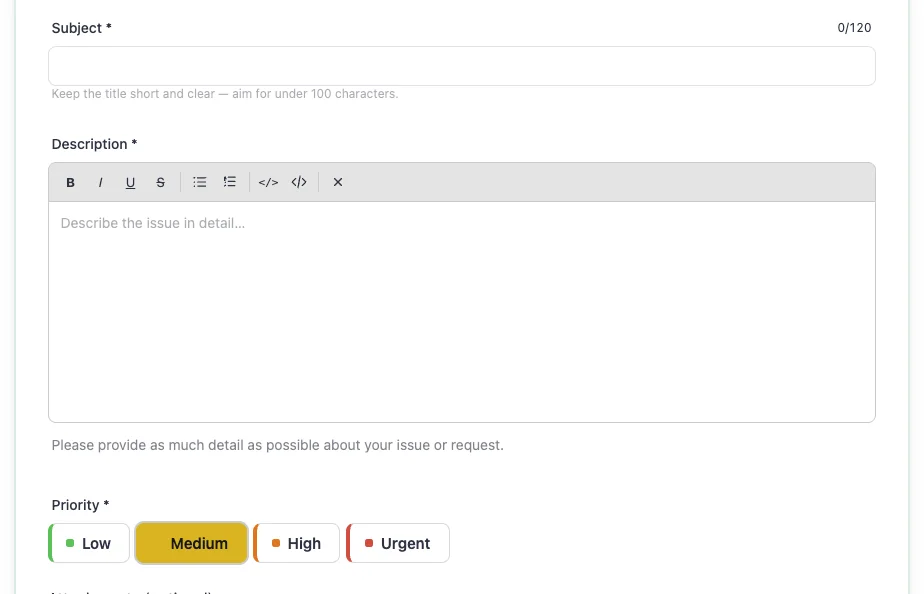 Synctivate support ticket form with subject, description, and priority
On the project side, George Hambel is stepping up from PM into a Director of Client Delivery role overseeing our full project team. George will still carry some of his own clients, but he's now got visibility across the whole group.
Why This Actually Matters to You
We spent the last year working with a coach to nail down exactly who we are as a company: our beliefs, our values, the kind of client for which we're built. More on that soon. But one piece of it is directly why this team exists. We'd rather have fewer clients and go deeper with them than chase volume. We want you to feel like we're wearing your company's logo on our chest, not like you hired a vendor who disappears the second the invoice is paid.
That's always been the goal. It just took us seven years to be big enough, and mature enough, to build it right. And honestly, we're not done. Every year, we're aiming to get a little better at this than we were the year before.
If you're a current client, you may have already talked to someone on the Customer Success Team, and you'll be seeing a lot more of them as we move toward October 1st. If you're not yet a client and this is the kind of partner you've been looking for, one that sticks around, let's talk.